LITHIUM BATTERY COMPLETE MASTERCLASS
শেয়ার
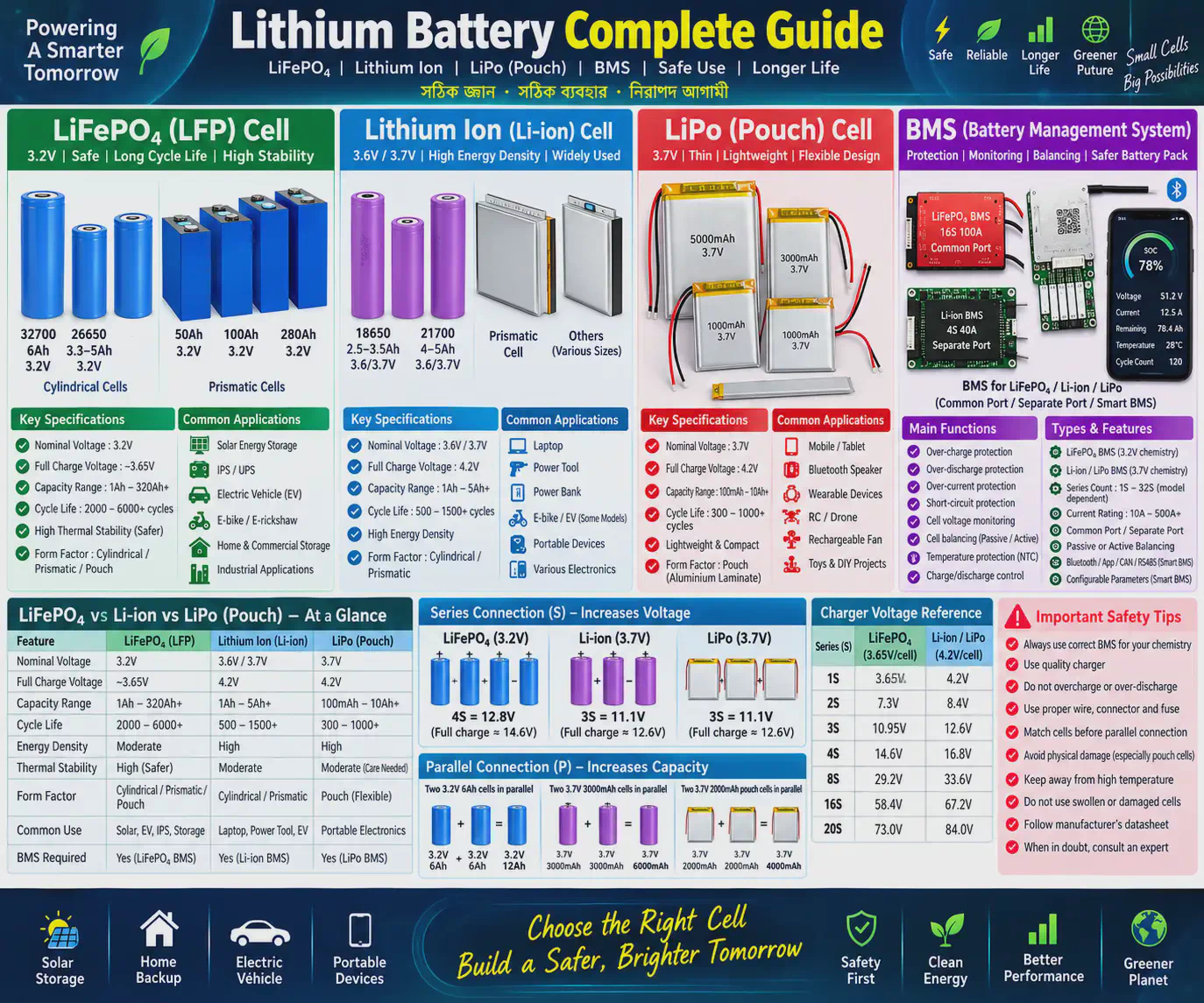
🔋 LITHIUM BATTERY COMPLETE MASTERCLASS
LiFePO₄ • Li-ion • LiPo/Pouch • BMS • Charger • Pack Design • Testing • Safety
বর্তমানে মোবাইল ফোন, Power Bank, Rechargeable Fan, Laptop, Power Tool, Solar System, IPS/UPS, E-bike, Easy Bike, Electric Vehicle থেকে শুরু করে বড় Energy Storage System—সব জায়গাতেই Lithium Battery ব্যবহার হচ্ছে।
কিন্তু “Lithium Battery” একটি single battery type নয়।
Lithium battery বুঝতে হলে জানতে হবে:
Chemistry → Cell → Voltage → Current → Capacity → Energy → Power → Series/Parallel → C-rate → Internal Resistance → BMS → Balancing → Charger → Thermal Management → Pack Design → Testing → Safety
এই লেখাটি সেই পুরো পথটি একসঙ্গে ব্যাখ্যা করবে।
অধ্যায় ১ — Battery-এর Basic Electrical Knowledge
1. Volt বা V কী?
Volt হলো electrical potential difference।
সহজভাবে বললে, battery কত voltage level-এ electrical energy supply করে তা Volt দিয়ে প্রকাশ করা হয়।
উদাহরণ:
LiFePO₄ cell ≈ 3.2V nominal
Conventional Li-ion ≈ 3.6V/3.7V nominal
12V lead-acid battery ≈ 12V nominal
4S LiFePO₄ pack ≈ 12.8V nominal
Nominal Voltage কী?
Battery discharge-এর পুরো সময় voltage এক থাকে না।
তাই manufacturer একটি representative voltage ব্যবহার করে, যাকে nominal voltage বলা হয়।
উদাহরণ:
LiFePO₄ cell:
Nominal ≈ 3.2V
কিন্তু full charge-এর কাছাকাছি:
≈ 3.65V
এবং discharge-এর সময় voltage ধীরে ধীরে কমে।
2. Ampere বা A কী?
Ampere হলো current।
Battery থেকে নির্দিষ্ট সময়ে কত electrical current প্রবাহিত হচ্ছে সেটি A দিয়ে প্রকাশ করা হয়।
উদাহরণ:
একটি motor চলার সময় যদি battery থেকে 40A নেয়:
Current = 40A
এটি battery capacity নয়।
3. Ah কী?
Ah = Ampere-hour
এটি battery-এর charge capacity-এর একটি measure।
উদাহরণ:
100Ah battery theoretically:
100A × 1 hour
অথবা
20A × 5 hours
অথবা
10A × 10 hours
সমপরিমাণ charge represent করে।
কিন্তু বাস্তবে runtime পুরোপুরি linear হয় না।
কারণ:
Efficiency
Temperature
BMS cutoff
Cell chemistry
Battery age
Voltage sag
Load profile
সবকিছু প্রভাব ফেলে।
4. A এবং Ah-এর পার্থক্য
এটি battery নিয়ে সবচেয়ে common confusion।
A = Current
Ah = Capacity
যেমন:
একটি cell:
3.2V 100Ah
আর cell maximum continuous current:
100A
এখানে:
100Ah = capacity
100A = current capability
দুটো এক জিনিস নয়।
5. Watt বা W কী?
Electrical power:
W = V × A
উদাহরণ:
48V system 50A current দিলে:
48 × 50
= 2400W
অর্থাৎ:
2.4kW
6. Wh এবং kWh কী?
Wh হলো stored energy বোঝার সবচেয়ে গুরুত্বপূর্ণ unitগুলোর একটি।
Formula:
Wh = V × Ah
Example 1
12.8V 100Ah battery:
12.8 × 100
= 1280Wh
= 1.28kWh
Example 2
51.2V 100Ah:
51.2 × 100
= 5120Wh
= 5.12kWh
Example 3
64V 195Ah:
64 × 195
= 12,480Wh
= 12.48kWh
এখান থেকে গুরুত্বপূর্ণ শিক্ষা:
শুধু Ah দিয়ে দুই battery-এর stored energy তুলনা করা ঠিক নয়।
অধ্যায় ২ — Lithium Battery Chemistry
7. Lithium Battery এক ধরনের নয়
Rechargeable lithium battery-এর অনেক chemistry আছে।
গুরুত্বপূর্ণ কয়েকটি:
LiFePO₄ / LFP
NMC
NCA
LCO
LMO
LTO
Market language-এ অনেক সময় এগুলোকে সহজভাবে:
LiFePO₄
এবং
Li-ion
বলে আলাদা করা হয়।
কিন্তু technically LiFePO₄-ও lithium-ion family-এর একটি chemistry।
8. LiFePO₄ / LFP কী?
LiFePO₄ =
Lithium Iron Phosphate
সাধারণ specification:
Nominal voltage:
≈ 3.2V
Upper charge voltage:
≈ 3.65V/cell
এটি manufacturer-specific specification দিয়ে verify করতে হবে।
LFP-এর সুবিধা
Long cycle-life potential
ভালো thermal stability
High-current variants পাওয়া যায়
Solar/ESS-এ জনপ্রিয়
EV application-এ ব্যবহার হয়
Cobalt-free cathode chemistry
ব্যবহার
Solar battery
IPS
UPS
EV
E-bike
Telecom backup
Home storage
Commercial ESS
9. Conventional Li-ion Cell
Consumer electronics-এ ব্যবহৃত অনেক NMC/NCA/LCO-based cell-এর nominal voltage:
3.6V বা 3.7V
Typical maximum charge:
4.2V
তবে সব cell 4.2V নয়।
কিছু high-voltage variant:
4.30V
4.35V
বা অন্য upper voltage ব্যবহার করতে পারে।
Li-ion ব্যবহার
Laptop
Power bank
Power tool
E-bike
Vacuum cleaner
Flashlight
Portable device
EV
10. LiPo কী?
LiPo সাধারণত:
Lithium Polymer
নামে পরিচিত।
কিন্তু গুরুত্বপূর্ণ distinction:
LiPo = chemistry/market terminology
Pouch = physical packaging format
অনেক consumer LiPo cell pouch format-এ থাকে।
Typical conventional LiPo:
Nominal:
3.7V
Full charge:
4.2V
কিন্তু model-specific datasheet অবশ্যই দেখতে হবে।
অধ্যায় ৩ — Cell Form Factor
11. Cylindrical Cell
গোলাকার metal-can cell।
Common sizes:
14500
18650
21700
26650
32650
32700
12. 18650 কী?
18650 নামটি roughly physical size বোঝায়।
প্রায়:
18mm diameter
65mm length
Typical reputable capacity model অনুযায়ী প্রায়:
2Ah–3.5Ah class
Example
3.6V 3Ah cell:
Energy:
3.6 × 3
= 10.8Wh
13. 21700 Cell
Approximate size:
21mm diameter
70mm length
অনেক model প্রায়:
3Ah–5Ah class
Example
3.6V 5Ah:
3.6 × 5
= 18Wh
14. 32700 LiFePO₄
LFP-এর একটি পরিচিত cylindrical format।
বাজারে প্রায়:
6Ah–7Ah class
cell পাওয়া যায়।
Example:
3.2V 6Ah
Energy:
3.2 × 6
= 19.2Wh
15. Prismatic Cell
Prismatic cell সাধারণত rectangular rigid case-এর cell।
বড় battery pack-এ বহুল ব্যবহৃত।
Example capacities:
50Ah
100Ah
105Ah
150Ah
200Ah
230Ah
280Ah
304Ah
314Ah
320Ah+
এগুলো universal fixed list নয়।
Manufacturer অনুযায়ী ভিন্ন হবে।
16. Pouch Cell
Pouch cell aluminium-laminate flexible packaging ব্যবহার করে।
সুবিধা:
Thin
Lightweight
Custom dimensions
Space-efficient
Capacity হতে পারে:
100mAh
500mAh
1Ah
2Ah
3Ah
5Ah
10Ah
বা আরও বেশি।
অধ্যায় ৪ — Series & Parallel
17. Series বা S
Series করলে:
Voltage যোগ হয়
Capacity Ah সাধারণত একই থাকে।
Example
চারটি 3.2V 100Ah LFP cell:
3.2 × 4
= 12.8V
Capacity:
100Ah
Result:
12.8V 100Ah
Energy:
12.8 × 100
= 1.28kWh
18. 16S LiFePO₄
16 × 3.2V
= 51.2V
যদি cell 100Ah:
Pack:
51.2V 100Ah
Energy:
51.2 × 100
= 5.12kWh
19. 20S LiFePO₄
20 × 3.2
= 64V
যদি cell:
195Ah
Pack:
64V 195Ah
Energy:
12.48kWh
20. Parallel বা P
Parallel করলে:
Voltage একই থাকে।
Ah যোগ হয়।
Example:
দুটি:
3.2V 6Ah
parallel করলে:
3.2V 12Ah
21. 4S2P Example
প্রতিটি cell:
3.2V 6Ah
2P:
Capacity:
6 × 2
= 12Ah
4S:
Voltage:
3.2 × 4
= 12.8V
Final pack:
12.8V 12Ah
Total cells:
4 × 2
= 8 cells
22. 16S4P Example
প্রতিটি cell:
3.2V 6Ah
Series:
16
Parallel:
4
Total cells:
16 × 4
= 64 cells
Voltage:
16 × 3.2
= 51.2V
Capacity:
4 × 6
= 24Ah
Pack:
51.2V 24Ah
Energy:
51.2 × 24
= 1228.8Wh
≈ 1.23kWh
অধ্যায় ৫ — C-Rate
23. C-rate কী?
C-rate battery capacity-এর তুলনায় charge/discharge current বোঝায়।
Example:
100Ah cell:
1C = 100A
0.5C = 50A
2C = 200A
Example:
6Ah cell:
1C = 6A
2C = 12A
0.5C = 3A
⚠️ কোনো battery 2C দিতে পারবে কিনা capacity দেখে অনুমান করা যাবে না।
Datasheet দেখতে হবে।
24. Charge C-rate Example
100Ah battery-কে:
20A charger দিলে:
20 ÷ 100
= 0.2C
50A charger:
50 ÷ 100
= 0.5C
অধ্যায় ৬ — Energy Cell vs Power Cell
25. Energy Cell
Design priority:
বেশি stored energy
Example:
3500mAh 18650
কিন্তু discharge rating তুলনামূলক কম হতে পারে।
26. Power Cell
Design priority:
High current delivery
Example:
2500mAh cell হয়তো 3500mAh cell-এর চেয়ে বেশি continuous current দিতে পারে।
তাই:
Higher Ah ≠ Automatically Better Cell
Application matter করে।
অধ্যায় ৭ — Internal Resistance
27. IR কী?
IR = Internal Resistance
Real battery cell-এর ভিতরে resistance থাকে।
IR যত বেশি:
Voltage sag বাড়তে পারে
Heat বাড়ে
Power loss বাড়ে
High-current performance কমে
28. I²R Heating
Heat loss:
P = I²R
ধরুন resistance:
0.005Ω
Current:
50A
P:
50² × 0.005
= 2500 × 0.005
= 12.5W heat
যদি current 100A হয়:
100² × 0.005
= 50W
অর্থাৎ current দ্বিগুণ হলেও heat চারগুণ হলো।
এ কারণেই high-current pack engineering critical।
29. Voltage Sag
Battery resting voltage:
52V
Heavy load দিলে:
47V
নেমে গেল।
এটি voltage sag।
Potential causes:
High cell IR
Thin cable
Weak connection
Small busbar
Low SOC
Cold battery
Old cell
Weak BMS
অধ্যায় ৮ — SOC, SOH এবং DoD
30. SOC
SOC = State of Charge
Battery-তে আনুমানিক কত charge আছে।
Example:
100% SOC
50% SOC
20% SOC
LFP-এর ক্ষেত্রে শুধু voltage দেখে SOC estimate করা কঠিন হতে পারে কারণ discharge curve-এর বড় অংশ relatively flat।
31. Coulomb Counting
Smart BMS current সময়ের সঙ্গে integrate করে SOC estimate করতে পারে।
Concept:
Ah used ≈ Current × Time
Example:
100Ah battery থেকে 10A করে 3 hours:
10 × 3
= 30Ah
idealভাবে remaining:
≈70Ah
কিন্তু calibration এবং efficiency matter করে।
32. SOH
SOH = State of Health
Battery নতুন অবস্থার তুলনায় এখন কতটা performance ধরে রেখেছে।
Example:
Rated capacity:
100Ah
Measured capacity:
82Ah
Capacity-based rough SOH:
82 ÷ 100 × 100
= 82%
কিন্তু professional SOH শুধু Ah দিয়ে নির্ধারণ করা হয় না।
IR এবং power capability-ও গুরুত্বপূর্ণ।
33. DoD
DoD = Depth of Discharge
100Ah battery থেকে 80Ah ব্যবহার করলে:
DoD ≈ 80%
Remaining SOC roughly:
20%
অধ্যায় ৯ — Cycle Life
34. Cycle কী?
একবার charger লাগানো মানেই এক cycle নয়।
Example:
Day 1:
50% discharge
Day 2:
আরও equivalent 50%
দুটি মিলে roughly একটি full equivalent cycle-এর charge throughput হতে পারে।
35. 6000 Cycle Claim কীভাবে দেখবেন?
Manufacturer যদি বলে:
6000 cycles
তখন জিজ্ঞেস করবেন:
কত DoD?
কত C-rate?
কত temperature?
কোন charge voltage?
End-of-life কত % capacity?
Test procedure কী?
6000 cycle at 80% DoD
এবং
6000 cycle at 100% DoD
এক claim নয়।
অধ্যায় ১০ — BMS
36. BMS কী?
BMS = Battery Management System
Battery pack-এর electronic protection, monitoring এবং control system।
Model অনুযায়ী function:
Cell voltage monitoring
Pack voltage monitoring
Overcharge protection
Over-discharge protection
Over-current protection
Short-circuit protection
Temperature monitoring
Balancing
SOC estimation
Communication
Charge/discharge control
37. Overcharge Protection
ধরুন LFP cell allowable upper voltage:
≈3.65V region
যদি কোনো cell limit ছাড়াতে থাকে:
BMS charge path বন্ধ করতে পারে।
⚠️ Exact threshold BMS এবং cell manufacturer অনুযায়ী নির্ধারিত হবে।
38. Under-voltage Protection
একটি cell খুব বেশি discharge হলে damage হতে পারে।
BMS configured lower threshold-এ discharge বন্ধ করতে পারে।
এটাকে:
Low-voltage cutoff
বা
Under-voltage protection
বলা হয়।
39. Over-current Protection
BMS current limit exceed করলে pack disconnect করতে পারে।
Example:
BMS continuous:
100A
Over-current protection threshold:
manufacturer/configuration অনুযায়ী অন্য value হতে পারে।
তাই শুধু “100A” label যথেষ্ট নয়।
40. Short-circuit Protection
Positive এবং negative path খুব কম resistance-এ short হলে enormous current flow হতে পারে।
BMS short-circuit detect করে disconnect করার চেষ্টা করতে পারে।
তবুও:
BMS = Fuse-এর replacement নয়।
41. BMS-এর S Count
4S = 4 series groups
8S = 8 series groups
16S = 16
20S = 20
Example:
16S LFP:
16 × 3.2
= 51.2V
20S:
= 64V
42. Chemistry Matching
3.2V LFP BMS এবং 3.7V conventional Li-ion BMS-এর voltage settings এক নয়।
তাই:
S count ঠিক হলেও chemistry ভুল হলে BMS ভুল।
43. BMS Ampere
Battery 100Ah হলেই:
100A BMS
অবশ্যই লাগবে—এটি ভুল ধারণা।
Example:
51.2V system
Load:
3000W
Current roughly:
3000 ÷ 51.2
= 58.6A
কিন্তু inverter surge ধরুন 100A-এর বেশি নিতে পারে।
তখন BMS selection continuous + peak requirement অনুযায়ী হবে।
অধ্যায় ১১ — Cell Balancing
44. কেন balancing লাগে?
চারটি cell:
Cell 1 = 3.45V
Cell 2 = 3.44V
Cell 3 = 3.37V
Cell 4 = 3.46V
Cell 3 অন্যদের থেকে পিছিয়ে।
একে imbalance বলা যায়।
45. Passive Balancing
Higher-voltage cell-এর energy resistor দিয়ে heat হিসেবে dissipate করা হয়।
Pros:
Simple
Cheap
Common
Cons:
Slow হতে পারে
Energy heat হিসেবে নষ্ট হয়
46. Active Balancing
Energy এক cell/group থেকে অন্য cell/group-এ transfer করা হয়।
Pros:
Larger imbalance correction-এ কার্যকর হতে পারে
Energy reuse করে
Cons:
More complex
More expensive
Active সবসময় automatically better নয়।
Application অনুযায়ী নির্বাচন করতে হয়।
অধ্যায় ১২ — Smart BMS
47. Smart BMS কী?
Communication-capable BMS।
Interfaces হতে পারে:
Bluetooth
CAN
RS485
UART
48. Smart BMS-এ কী দেখা যায়?
Model অনুযায়ী:
Cell voltage
Pack voltage
Current
SOC
Temperature
Cycle count
Alarm
MOS status
Balance status
49. CAN কী?
CAN = Controller Area Network
EV, inverter, charger এবং BMS-এর মধ্যে communication-এ widely used।
Example:
BMS inverter-কে বলতে পারে:
“Maximum charging current = 50A”
Inverter সেই অনুযায়ী charging limit করতে পারে।
অধ্যায় ১৩ — Charger
50. Lithium Charger কীভাবে কাজ করে?
অনেক lithium charging system:
CC/CV
ব্যবহার করে।
CC:
Constant Current
CV:
Constant Voltage
51. CC Example
100Ah battery
20A charging:
Initial charge rate:
≈0.2C
Battery upper voltage region-এ পৌঁছানো পর্যন্ত charger current control করে।
52. CV Stage
Battery upper charging voltage-এ পৌঁছানোর পর charger voltage ধরে রাখে।
Current ধীরে ধীরে কমে।
Charge termination criteria charger এবং chemistry অনুযায়ী হয়।
53. LFP Charger Voltage Examples
Per-cell reference:
≈3.65V
4S:
4 × 3.65
= 14.6V
8S:
= 29.2V
16S:
= 58.4V
20S:
= 73V
54. Conventional Li-ion Charger
Per cell:
≈4.2V
2S:
8.4V
3S:
12.6V
4S:
16.8V
⚠️ Exact datasheet final authority।
অধ্যায় ১৪ — Runtime Calculation
55. Simple Runtime
Battery:
51.2V 100Ah
Energy:
5120Wh
Load:
1000W
Ideal runtime:
5120 ÷ 1000
= 5.12 hours
বাস্তবে কম হতে পারে।
56. Efficiency ধরলে
ধরুন system efficiency:
90%
Usable energy:
5120 × 0.90
= 4608Wh
Runtime:
4608 ÷ 1000
≈ 4.61 hours
57. Usable SOC Window ধরলে
ধরুন শুধু 90% energy ব্যবহার করবেন:
5120 × 0.90
= 4608Wh
Inverter efficiency 90%:
4608 × 0.90
= 4147Wh
1000W load:
≈ 4.15 hours
এটাই theoretical value-এর চেয়ে realistic estimate।
অধ্যায় ১৫ — Battery Pack Current
58. Motor Example
Motor/controller power:
3000W
Battery:
64V
Current:
3000 ÷ 64
≈ 46.9A
কিন্তু acceleration-এ 80A বা তার বেশি transient হতে পারে।
তাই শুধু motor nameplate দিয়ে BMS নির্বাচন করবেন না।
Controller current limit দেখুন।
59. Inverter Example
Inverter load:
5000W
Battery:
51.2V
Ideal DC current:
5000 ÷ 51.2
≈ 97.7A
যদি efficiency 90%:
Battery power required:
5000 ÷ 0.9
≈5556W
Current:
5556 ÷ 51.2
≈ 108.5A
অর্থাৎ 100A BMS যথেষ্ট নাও হতে পারে।
অধ্যায় ১৬ — Cell Matching
60. কেন matching দরকার?
এক pack-এ ideally cells হওয়া উচিত:
Same chemistry
Same model
Similar capacity
Similar IR
Similar age
Similar condition
Similar SOC
61. Weak Cell Example
16টি 100Ah cell।
15টি actual:
≈100Ah
একটি:
≈70Ah
Series pack usable capacity অনেক ক্ষেত্রে weak cell দ্বারা সীমিত হবে।
অর্থাৎ পুরো pack 100Ah label থাকলেও weak cell আগে cutoff-এ পৌঁছাতে পারে।
অধ্যায় ১৭ — Cell Grade
62. Grade A কী?
Battery market-এ “Grade A” বলতে সাধারণত manufacturer specification meeting, production-grade cell বোঝানোর চেষ্টা করা হয়।
কিন্তু terminology standardized retail guarantee নয়।
Seller “A Grade” লিখলেই সত্য প্রমাণ হয় না।
যাচাই করুন:
Manufacturer
Model
Batch
QR
Capacity
IR
Date
Supplier traceability
63. Grade B
Grade B শব্দটির অর্থ seller/manufacturer অনুযায়ী ভিন্ন হতে পারে।
Potential reasons:
Capacity variation
IR variation
Cosmetic issue
Manufacturing tolerance
Aging
তাই:
Grade letter-এর চেয়ে measurement গুরুত্বপূর্ণ।
64. Used / Recovered Cell
EV বা অন্য battery pack খুলে recovered cell বিক্রি হতে পারে।
এগুলো নতুনের মতো দেখতে পারে।
Potential issues:
Reduced capacity
Increased IR
Unequal aging
Unknown cycle history
Used cell unusable নয়।
কিন্তু testing ছাড়া new cell হিসেবে নেওয়া ঠিক নয়।
অধ্যায় ১৮ — Fake Capacity
65. 18650 9900mAh?
Unknown 18650-এর গায়ে যদি লেখা থাকে:
7000mAh
8800mAh
9900mAh
তখন সন্দেহ করুন।
শুধু label specification নয়।
যাচাই করুন:
Manufacturer
Official datasheet
Weight
Capacity test
IR
অধ্যায় ১৯ — Capacity Testing
66. Capacity Test Concept
Cell:
Correct specification অনুযায়ী charge
Rest
Controlled current-এ discharge
Correct cutoff voltage পর্যন্ত
Ah এবং Wh measure
Example:
Rated:
100Ah
Test result:
96Ah
Then actual measured capacity:
≈96Ah
Test conditionও record করতে হবে।
67. Energy Test
51.2V pack শুধু Ah দিয়ে নয়, Wh দিয়েও test করা ভালো।
যদি discharge test result:
4.8kWh
তাহলে actual usable energy সম্পর্কে ভালো ধারণা পাওয়া যায়।
অধ্যায় ২০ — Internal Resistance Testing
68. IR Meter
Cell matching করতে IR measurement helpful।
কিন্তু:
different instrument → different results হতে পারে।
তাই comparison করুন:
Same meter
Same SOC
Same temperature
Same method
অধ্যায় ২১ — Temperature
69. High Temperature
High temperature degradation accelerate করতে পারে।
Effects:
Faster aging
Higher side reactions
Safety risk
Shorter lifespan
70. Low Temperature
Cold environment:
Power capability কমতে পারে
Voltage sag বাড়তে পারে
Charging limitations আসে
অনেক conventional LFP cell 0°C-এর নিচে charge করা উচিত নয়, unless manufacturer design allows it বা heating/control ব্যবস্থা থাকে।
অধ্যায় ২২ — Thermal Runaway
71. Thermal Runaway কী?
Battery cell-এর internal temperature এমনভাবে বাড়তে পারে যেখানে self-heating reaction নিজেই accelerate হয়।
Potential trigger:
Severe overcharge
Internal short
External short
Mechanical damage
Manufacturing defect
Extreme heat
LFP সাধারণত অনেক nickel-rich lithium-ion chemistry-এর তুলনায় বেশি thermally stable, কিন্তু LFP risk-free নয়।
অধ্যায় ২৩ — Pouch Cell Safety
72. Pouch Cell কেন আলাদা?
Pouch casing rigid metal can নয়।
তাই:
Puncture
Crushing
Folding
Swelling
Mechanical stress
বিশেষ risk তৈরি করতে পারে।
73. Swollen Cell
Pouch battery ফুলে গেলে:
❌ চাপ দিয়ে flat করবেন না
❌ puncture করবেন না
❌ continued normal use করবেন না
Properly isolate এবং applicable disposal/recycling process অনুসরণ করুন।
অধ্যায় ২৪ — Cable, Busbar এবং Connector
74. Cable কেন গুরুত্বপূর্ণ?
High current thin cable দিয়ে গেলে:
Voltage drop
Heat
Power loss
Insulation damage
হতে পারে।
75. Voltage Drop Example
Cable resistance:
0.01Ω
Current:
100A
Voltage drop:
V = IR
=100 × 0.01
= 1V
Power loss:
100² × 0.01
= 100W
এই 100W heat হিসেবে dissipate হতে পারে।
76. Busbar
Prismatic cell connection-এ busbar ব্যবহৃত হয়।
Busbar design depends on:
Current
Material
Thickness
Width
Length
Joint resistance
Temperature rise
77. Connector
Connector current rating যথেষ্ট না হলে:
Heating
Arcing
Melting
Failure
হতে পারে।
অধ্যায় ২৫ — Fuse
78. BMS থাকলে Fuse দরকার?
অনেক pack design-এ:
হ্যাঁ।
BMS electronic protection।
Fuse independent electrical protection layer।
Critical failure-এ fuse circuit disconnect করতে পারে।
অধ্যায় ২৬ — Pre-charge
79. Pre-charge Circuit কী?
Large inverter-এর input capacitors initially empty থাকলে battery connect করার মুহূর্তে huge inrush current হতে পারে।
Pre-charge resistor/circuit capacitor ধীরে charge করে।
এরপর main contactor close হয়।
80. Pre-charge Example
5000W inverter battery connect করার মুহূর্তে normal load না থাকলেও input capacitor enormous current চাইতে পারে।
Direct connection:
Spark
Connector damage
Contactor welding
হতে পারে।
Pre-charge এই stress কমায়।
অধ্যায় ২৭ — Contactor vs MOSFET BMS
81. MOSFET BMS
Small/medium packs-এ electronic MOSFET switches common।
Advantages:
Compact
Fast switching
No mechanical contact
82. Contactor-based BMS
Large EV/ESS systems-এ high-current contactor ব্যবহার করা হতে পারে।
Components:
Main positive contactor
Main negative contactor
Pre-charge contactor
Pre-charge resistor
অধ্যায় ২৮ — Cell Compression
83. Prismatic Cell Compression
কিছু prismatic cell manufacturer pack assembly-তে specified compression/fixture requirement দিতে পারে।
Random অতিরিক্ত compression করা ঠিক নয়।
Always follow:
manufacturer mechanical specification
অধ্যায় ২৯ — SOC Calibration
84. Smart BMS 100% দেখাচ্ছে মানেই battery আসলে 100%?
না।
SOC algorithm ভুল calibration হলে inaccurate হতে পারে।
সঠিক configuration দরকার:
Rated capacity
Full-charge detection
Current calibration
Cell voltage
Coulomb counter reset
অধ্যায় ৩০ — Calendar Aging
85. Battery ব্যবহার না করলেও কি degrade হয়?
হ্যাঁ।
এটাকে calendar aging বলা হয়।
Influencing factors:
Temperature
SOC
Chemistry
Time
তাই “unused battery” সবসময় “new-performance battery” নয়।
অধ্যায় ৩১ — Cycle Aging
86. Cycle Aging
Charge/discharge cycling-এর কারণে degradation।
Depends on:
C-rate
DoD
Temperature
SOC window
Chemistry
অধ্যায় ৩২ — Self-discharge
87. Self-discharge
Battery connected না থাকলেও সময়ের সাথে charge কিছুটা কমতে পারে।
Pack-এর ক্ষেত্রে BMS standby consumption-ও battery drain করতে পারে।
অধ্যায় ৩৩ — Parasitic Drain
88. BMS নিজেই Battery খরচ করে?
হ্যাঁ, Smart BMS/Bluetooth circuitry কিছু standby current consume করতে পারে।
Long storage-এ এটি গুরুত্বপূর্ণ।
অধ্যায় ৩৪ — Battery Storage
89. Storage-এর সময়
Manufacturer recommendation অনুসরণ করুন।
General consideration:
Extreme heat এড়িয়ে চলা
Moisture থেকে সুরক্ষা
Short-circuit prevention
Proper SOC range
Periodic voltage inspection যেখানে প্রয়োজন
অধ্যায় ৩৫ — BMS Selection Checklist
90. BMS কেনার আগে দেখুন
Chemistry
S count
Continuous current
Peak current
Peak duration
Charge current
Cell over-voltage setting
Cell under-voltage setting
Over-current setting
Short-circuit protection
Temperature sensors
Low-temperature charge protection
Balance type
Balance current
CAN/RS485
Common/separate port
MOSFET/contactor architecture
অধ্যায় ৩৬ — Charger Selection Checklist
91. Charger কেনার সময়
দেখুন:
Battery chemistry
Series count
Maximum pack voltage
Charging current
CC/CV profile
BMS compatibility
Communication requirement
Connector polarity
Temperature behavior
অধ্যায় ৩৭ — Battery Buying Checklist
92. Seller-কে 20টি প্রশ্ন
Cell chemistry কী?
Manufacturer কে?
Exact model কী?
Cell নতুন কি?
Production date?
Rated capacity?
Tested capacity?
Nominal voltage?
Maximum charge voltage?
Recommended charge current?
Max continuous discharge?
Peak discharge?
IR কত?
Cycle-life claim কোন condition-এ?
QR traceable?
Cell matched?
BMS brand/model?
BMS continuous/peak current?
Charger specification কী?
Warranty কী cover করে?
অধ্যায় ৩৮ — Pack Diagnosis
93. Pack হঠাৎ বন্ধ হয়ে যায়
Possible causes:
One cell hits low voltage
BMS over-current
Temperature protection
Loose connector
Weak cell
BMS fault
Smart BMS cell voltages inspect করুন।
94. Battery দ্রুত শেষ হয়
Possible causes:
Capacity degradation
Fake Ah
Weak cell
High load
Incorrect SOC
Inverter loss
High IR
95. Battery Charge নেয় না
Potential causes:
Charger failure
BMS charge MOS off
Cell over-voltage
Temperature protection
Wiring fault
Connector issue
96. One Cell Voltage বেশি
Potential causes:
Imbalance
Lower capacity cell
Poor balancing
Connection/sense-wire issue
অধ্যায় ৩৯ — Practical Pack Example
97. 51.2V 100Ah LFP Pack
Cell:
3.2V 100Ah
Number:
16 cells
Configuration:
16S1P
Nominal voltage:
16 × 3.2
= 51.2V
Capacity:
100Ah
Energy:
51.2 × 100
= 5.12kWh
Maximum charge reference:
16 × 3.65
= 58.4V
যদি inverter:
3kW
Ideal current:
3000 ÷ 51.2
≈ 58.6A
90% system efficiency ধরলে battery side current আরও বেশি হবে।
এই pack-এর জন্য BMS নির্বাচন করতে:
Cell discharge rating
Inverter continuous current
Surge current
Charge current
সব বিবেচনা করতে হবে।
98. 12.8V 12Ah Pack Example
Cell:
3.2V 6Ah
Configuration:
4S2P
Cells:
8
Voltage:
12.8V
Capacity:
12Ah
Energy:
12.8 × 12
= 153.6Wh
99. 3S Li-ion Example
Cell:
3.7V 2500mAh
3S1P:
Nominal:
3 × 3.7
= 11.1V
Capacity:
2.5Ah
Energy:
11.1 × 2.5
= 27.75Wh
Full charge:
3 × 4.2
= 12.6V
100. 3S2P Example
Same 3.7V 2.5Ah cells।
Total cells:
6
Nominal:
11.1V
Capacity:
5Ah
Energy:
55.5Wh
অধ্যায় ৪০ — Safety Standards
Battery application অনুযায়ী বিভিন্ন international standard relevant হতে পারে।
Industrial lithium cells/batteries-এর ক্ষেত্রে IEC 62619 safety requirements ও tests নির্ধারণ করে; portable sealed secondary lithium cells/batteries-এর জন্য IEC 62133-2 একটি গুরুত্বপূর্ণ standard।
Lithium cell/battery transport-এর ক্ষেত্রে UN Manual of Tests and Criteria-এর Subsection 38.3 অত্যন্ত গুরুত্বপূর্ণ। Transport করার আগে applicable battery type UN 38.3 requirements meet করে কিনা যাচাই করা হয়।
Stationary/motive auxiliary battery systems-এর ক্ষেত্রে UL 1973 এবং complete energy-storage system-এর ক্ষেত্রে UL 9540/9540A relevant হতে পারে।
EV rechargeable energy-storage system abuse testing-এর জন্য SAE J2464 একটি পরিচিত framework।
⚠️ Standard selection application, country, product category এবং regulatory requirement অনুযায়ী ভিন্ন হয়।
অধ্যায় ৪১ — যে ভুলগুলো সবচেয়ে বেশি হয়
❌ A আর Ah এক মনে করা
❌ শুধু Ah দেখে battery compare করা
❌ LiFePO₄ এবং 3.7V Li-ion একই charger দিয়ে charge করা
❌ Chemistry না দেখে BMS কেনা
❌ 100Ah = 100A BMS মনে করা
❌ Random cells parallel করা
❌ BMS আছে বলে fuse বাদ দেওয়া
❌ Cycle claim test condition ছাড়া বিশ্বাস করা
❌ QR থাকলেই original মনে করা
❌ A Grade sticker দেখেই বিশ্বাস করা
❌ 9900mAh 18650 label বিশ্বাস করা
❌ Cable size ignore করা
❌ Connector rating ignore করা
❌ Pack temperature monitor না করা
❌ Swollen pouch cell ব্যবহার করা
❌ BMS protection setting না বুঝে change করা
❌ Charger voltage manually বাড়ানো
❌ Cell matching ছাড়া pack তৈরি করা
অধ্যায় ৪২ — Master Formula Sheet
মনে রাখুন:
Energy
Wh = V × Ah
Power
W = V × A
Current
A = W ÷ V
Basic Runtime
Hours ≈ Battery Wh ÷ Load W
More realistic runtime
Runtime ≈ Battery Wh × usable fraction × system efficiency ÷ load
C-rate
Current = Ah × C-rate
Series
Voltage যোগ হয়
Parallel
Capacity যোগ হয়
Resistive Heat
P = I²R
Voltage Drop
Vdrop = I × R
অধ্যায় ৪৩ — Battery Expert হতে Knowledge Roadmap
Level 1 — Electrical Basics
শিখুন:
V
A
Ah
W
Wh
kWh
Series
Parallel
Level 2 — Cell Knowledge
শিখুন:
Chemistry
Nominal voltage
Capacity
C-rate
IR
SOC
SOH
DoD
Cycle life
Level 3 — Battery Pack
শিখুন:
S/P configuration
Cell matching
Busbar
Cable
Connector
Fuse
Mechanical structure
Level 4 — BMS
শিখুন:
Cell monitoring
Protection
Balancing
MOSFET
Contactor
CAN
RS485
SOC estimation
Level 5 — Charging
শিখুন:
CC/CV
Charge voltage
Charge current
C-rate
Temperature limits
Charger-BMS communication
Level 6 — Advanced Engineering
শিখুন:
Thermal management
Pre-charge
Insulation
Isolation monitoring
Current sensing
Fault analysis
Data logging
Pack validation
Cell compression
HV architecture
Level 7 — Testing & Safety
শিখুন:
Capacity testing
IR testing
Cycle testing
Abuse testing
Transport requirements
IEC standards
UN 38.3
UL standards
Applicable EV/ESS requirements
⭐ শেষ শিক্ষা
Battery-এর sticker দেখে Battery বিচার করবেন না।
“100Ah”
“6000 cycle”
“Grade A”
“Smart BMS”
“High Power”
— এগুলো marketing label হতে পারে।
সত্যিকারের evaluation করতে দেখুন:
**Chemistry
Manufacturer
Exact Model
Datasheet
Actual Capacity
Internal Resistance
C-rate
Cell Matching
BMS
Charger
Cable
Busbar
Fuse
Thermal Design
Mechanical Design
Testing
Traceability**
সব মিলিয়েই battery quality।
🔋 একটি ভালো Battery System-এর Formula
**Quality Cells
Correct Chemistry
Proper Cell Matching
Correct BMS
Proper Balancing
Correct Charger
Correct Current Design
Proper Cable & Busbar
Fuse & Protection
Temperature Management
Strong Mechanical Construction
Proper Testing & Quality Control
= Reliable & Safer Battery System**
সবশেষে একটি কথাই সবচেয়ে গুরুত্বপূর্ণ:
“Battery সম্পর্কে অনুমান নয়—Datasheet, QR code, Measurement এবং Engineering-এর ওপর সিদ্ধান্ত নিন।”
মন্তব্য
প্রথম মন্তব্য করুন।
লোড হচ্ছে…