Lead-Acid to Lithium Battery Replacement Guide Bangladesh
Discover which lead-acid batteries commonly used in Bangladesh can be replaced with LiFePO₄ lithium batteries. This guide covers UPS, IPS, solar systems, CCTV, emergency lighting, easy bikes, Mishuk, electric rickshaws, telecom, and industrial applications, with practical voltage and capacity replacement guidance.
শেয়ার
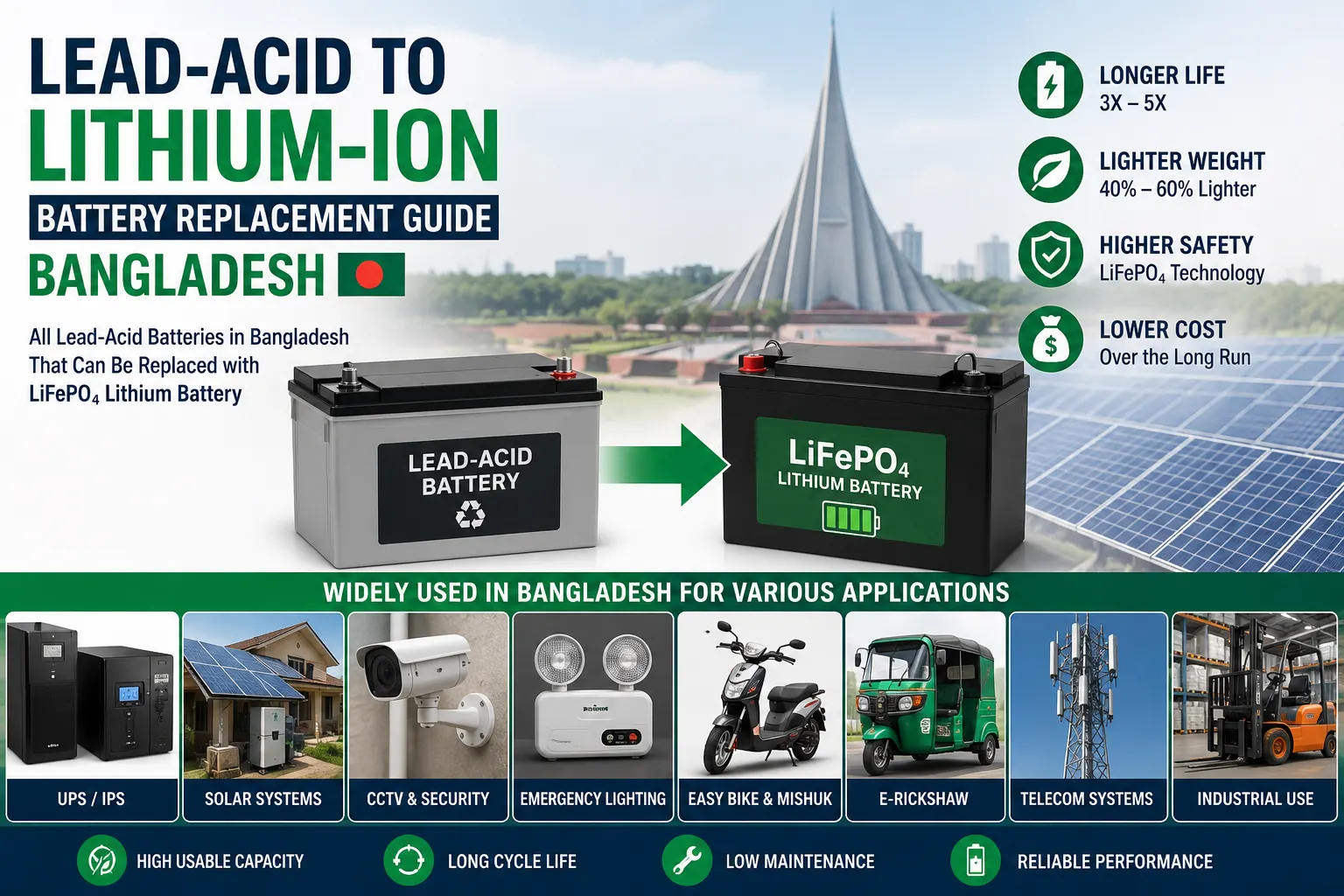
Yes. In Bangladesh, a very large portion of the lead-acid battery market can technically be replaced by LiFePO₄ lithium batteries, but the replacement must be designed around voltage, charger profile, discharge current, BMS, physical dimensions, and terminal layout.
One correction first: the chemistry you should focus on is Lithium Iron Phosphate (LiFePO₄/LFP) rather than generic “lithium-ion.” LFP is generally better suited to lead-acid replacement because of its cycle life, thermal stability, flat discharge voltage, and suitability for deep-cycle applications.
Bangladesh's current market covers small 4V/6V SLA batteries, 12V UPS batteries from roughly 7Ah through 200Ah, motorcycle starter batteries around 2.5–9Ah, automotive batteries from roughly 35Ah upward, IPS/solar batteries commonly 100–220Ah+, and traction batteries around 140–200Ah per 12V unit for easy bikes and similar vehicles. Star Tech
1. Master lead-acid → lithium replacement list
Lead-acid battery | Common Bangladesh use | Recommended lithium replacement | Opportunity |
|---|---|---|---|
4V 4–4.5Ah | Rechargeable lights, emergency lights, small electronics | Custom lithium system; not simple LFP drop-in | 🟡 |
6V 4–4.5Ah | Emergency light, security equipment, toys, small UPS | 6.4V 4–5Ah LiFePO₄ | 🟢 |
6V 7Ah | Emergency lights, exit lights, alarms | 6.4V 7Ah LiFePO₄ | 🟢 |
6V 10–12Ah | Lighting, equipment, small backup | 6.4V 10–12Ah LFP | 🟡 |
12V 2.5Ah | Motorcycle | 12.8V LFP starter battery | 🟡 |
12V 4Ah | Motorcycle, small equipment | 12.8V 4Ah LFP | 🟡 |
12V 4.5Ah | UPS, lighting, security | 12.8V 4.5–5Ah LFP | 🟢 |
12V 5Ah | Motorcycle | 12.8V starter LFP | 🟡 |
12V 6–6.5Ah | Motorcycle | 12.8V starter LFP | 🟡 |
12V 7Ah | UPS, CCTV, alarm, fire system, emergency light | 12.8V 7Ah LFP | 🟢🟢 |
12V 7.2/7.5Ah | UPS | 12.8V 7–8Ah LFP | 🟢🟢 |
12V 8/8.2/8.5Ah | UPS, backup | 12.8V 8–9Ah LFP | 🟢🟢 |
12V 9Ah | UPS, emergency lighting, motorcycle | 12.8V 9Ah LFP | 🟢🟢 |
12V 12Ah | UPS, CCTV, solar, DC equipment | 12.8V 12Ah LFP | 🟢🟢 |
12V 18Ah | UPS, inverter, medical/backup equipment | 12.8V 18–20Ah LFP | 🟢 |
12V 20Ah | Solar, small inverter, mobility equipment | 12.8V 20Ah LFP | 🟢 |
12V 26Ah | UPS, backup | 12.8V 25–30Ah LFP | 🟢 |
12V 30Ah | Solar, UPS, equipment | 12.8V 30Ah LFP | 🟢 |
12V 35Ah | Generator, automotive, UPS | 12.8V 35–40Ah LFP | 🟡 |
12V 38Ah | UPS | 12.8V 40Ah LFP | 🟢 |
12V 40Ah | UPS, solar, inverter | 12.8V 40Ah LFP | 🟢🟢 |
12V 42Ah | UPS/telecom | 12.8V 40–50Ah LFP | 🟢 |
12V 45Ah | Car, generator, solar | 12.8V 45–50Ah | 🟡 |
12V 55Ah | Automotive, backup | 12.8V 50–60Ah | 🟡 |
12V 60Ah | Cars, microbus, generator | 12.8V 60Ah | 🟡 |
12V 65Ah | UPS, solar, telecom | 12.8V 65–70Ah | 🟢🟢 |
12V 70Ah | UPS, automotive, generator | 12.8V 70Ah | 🟢 |
12V 75Ah | Automotive/industrial/backup | 12.8V 75–80Ah | 🟢 |
12V 80Ah | UPS, solar, automotive | 12.8V 80Ah | 🟢 |
12V 100Ah | IPS, solar, UPS, telecom, generator | 12.8V 100Ah LFP | 🟢🟢🟢 |
12V 105Ah | Industrial/automotive | 12.8V 100–105Ah | 🟢 |
12V 110Ah | Industrial, backup | 12.8V 100–110Ah | 🟢 |
12V 120Ah | IPS, solar, UPS, EV/rickshaw | 12.8V 120Ah LFP | 🟢🟢🟢 |
12V 130Ah | Rickshaw/traction | 12.8V 130Ah or full lithium traction pack | 🟢🟢 |
12V 140Ah | Easy bike / Mishuk / traction | Prefer complete 48/60/64V LFP pack | 🟢🟢🟢 |
12V 150Ah | IPS, solar, easy bike | 12.8V 150Ah or complete traction pack | 🟢🟢🟢 |
12V 160Ah | Easy bike, Mishuk | Complete LFP traction pack | 🟢🟢🟢 |
12V 165Ah | IPS/automotive/traction | 12.8V 160–165Ah | 🟢🟢 |
12V 180Ah | Easy bike, IPS, solar, industrial | 12.8V 180Ah / complete EV pack | 🟢🟢🟢 |
12V 185Ah | UPS/industrial/solar | 12.8V 180–200Ah | 🟢🟢 |
12V 200Ah | Easy bike, IPS, solar, telecom | 12.8V 200Ah LFP / full EV pack | 🟢🟢🟢 |
12V 215Ah | IPS/solar/industrial | 12.8V 200–220Ah | 🟢🟢 |
12V 220Ah | IPS/solar | 12.8V 200–220Ah LFP | 🟢🟢🟢 |
12V 230Ah+ | IPS, solar, industrial | 12.8V 230Ah+ or 24/48V ESS | 🟢🟢 |
Bangladesh government procurement documents themselves show lead-acid capacities including 4Ah, 9Ah, 35Ah, 45Ah, 60Ah, 70Ah, 75Ah, 80Ah, 100Ah, 105Ah, 110Ah, 120Ah, 180Ah and 200Ah. Current UPS sellers add sizes such as 7/7.5/8.2/9/12/18/26/38/40/65/70/80/100/120/150/200Ah. Navy Khulna
2. Small emergency-light batteries
6V 4.5Ah
This is an important small-battery market.
Used in
Emergency lights
Factory emergency lighting
Exit/fog lights
Rechargeable fans
Alarm systems
Security systems
Children's electric toys
Small portable equipment
Bangladeshi manufacturer/supplier listings explicitly show 6V 4.5Ah lead-acid batteries in emergency lighting, while local electronics sellers list the same format for fans, emergency lamps, toys and backup systems. Oraska
Lithium replacement
Lead acid:6V 4.5Ah
→
LiFePO₄:6.4V 4.5Ah / 5Ah
A built-in 2S LFP BMS should be used.
Commercial attractiveness
⭐⭐⭐⭐☆
The unit price is relatively low, but the market is broad.
3. 12V 7Ah–9Ah — one of the biggest small-battery markets
This category deserves particular attention.
Common capacities
12V 7Ah
12V 7.2Ah
12V 7.5Ah
12V 8Ah
12V 8.2Ah
12V 8.5Ah
12V 9Ah
Current Bangladeshi UPS listings contain many of these sizes. Star Tech
Applications
Computer UPS
CCTV
DVR/NVR backup
Router/network backup
Fire alarm panel
Intrusion alarm
Emergency lighting
Access-control systems
Medical equipment
Solar electronics
Small DC systems
A current Bangladesh listing for a 12V 7Ah SLA specifically identifies UPS, emergency lighting, alarm/security, medical and solar applications. Star Tech
Replacement
12V 7Ah SLA
→ 12.8V 7Ah LiFePO₄
12V 9Ah SLA
→ 12.8V 9Ah LiFePO₄
Important issue ⚠️
Do not assume every computer UPS accepts an ordinary LFP battery.
The lithium battery should have:
appropriate BMS
sufficient peak discharge current
correct terminals
correct dimensions
compatibility with the UPS charging voltage
This is therefore a good market for a product specifically branded as:
12.8V LiFePO₄ UPS Replacement Battery
rather than an ordinary generic LFP battery.
4. 12V 12Ah–40Ah
Common Bangladesh sizes include:
12Ah
18Ah
26Ah
35Ah
38Ah
40Ah
Current local UPS catalogs list 12Ah, 18Ah, 26Ah, 38/40Ah and higher capacities. Star Tech
Applications
Medium UPS
Online UPS
CCTV systems
Security systems
Small IPS
Small solar storage
Telecom/network equipment
DC lighting
Medical equipment
Generator starting in some applications
Recommended LFP range
12.8V 12Ah
12.8V 18Ah
12.8V 20Ah
12.8V 26/30Ah
12.8V 40Ah
Commercial attractiveness
⭐⭐⭐⭐☆
5. IPS / inverter / home backup batteries
This is one of the largest opportunities for lithium replacement in Bangladesh.
Common lead-acid capacities include:
100Ah
120Ah
150Ah
180Ah
200Ah
220Ah
230Ah+
Bangladesh currently has products such as 120Ah tubular, 150Ah tubular, 200Ah tubular and 220Ah-class batteries in the IPS market. Current 200Ah products are sold specifically for IPS, UPS, inverter and solar applications. BDStall
Replacement table
Lead acid | LFP replacement |
|---|---|
12V 100Ah | 12.8V 100Ah |
12V 120Ah | 12.8V 120Ah |
12V 150Ah | 12.8V 150Ah |
12V 180Ah | 12.8V 180Ah |
12V 200Ah | 12.8V 200Ah |
12V 220Ah | 12.8V 220Ah |
There are already 12.8V 200Ah LFP batteries in the Bangladesh IPS market, demonstrating that this substitution is commercially established. BDStall
Commercial attractiveness
⭐⭐⭐⭐⭐
I would consider:
12.8V 100Ah → 150Ah → 200Ah
three of the most important LFP sizes for Bangladesh.
6. Solar batteries
Lead-acid remains widely used for solar storage in Bangladesh. Current market listings describe lead-acid as a common solar-storage chemistry and show products such as 12V 200Ah tubular batteries used for solar/IPS. BDStall
Common sizes:
12V 40Ah
12V 65Ah
12V 80Ah
12V 100Ah
12V 120Ah
12V 150Ah
12V 180Ah
12V 200Ah
12V 220Ah
Better lithium solution
For very small systems:
12.8V LFP
For medium systems:
25.6V LFP
For larger systems:
51.2V LFP
For example:
4 × 12V lead-acid batteries
can often be replaced more cleanly with:
1 × 51.2V LiFePO₄ battery bank
rather than installing four separate 12.8V batteries.
7. Easy bike / ইজিবাইক
This is probably the single most interesting lithium-conversion market.
Bangladesh sources show easy-bike batteries in:
140Ah
160Ah
180Ah
200Ah
Local listings explicitly sell 12V 140Ah, 160Ah, 180Ah and 200Ah easy-bike batteries, while a Bangladesh Navy technical specification calls for a Hamko 12V 200Ah wet lead-acid easy-bike battery. Miraz Battery
One Bangladesh easy-bike study found vehicles using five 12V 180Ah batteries, forming a 60V nominal lead-acid bank. ResearchGate
Typical architecture
Lead acid
12V × 5
=
60V lead-acid system
For example:
5 × 12V 180Ah
Lithium
A much better conversion is usually:
64V LiFePO₄
rather than:
5 × 12.8V independent LFP batteries
because a single integrated pack can have:
one smart BMS
cell balancing
one charge connector
battery SOC display
high-current protection
CAN/UART/Bluetooth if required
stronger mechanical packaging
Good potential lithium sizes
64V 100Ah
64V 120Ah
64V 150Ah
64V 160Ah
64V 180Ah
64V 195Ah
64V 200Ah
Commercial attractiveness
⭐⭐⭐⭐⭐
This is one of the markets I would prioritize.
8. Mishuk / electric rickshaw / auto-rickshaw
Typical lead-acid systems are banks of 12V traction batteries.
Common pack architectures include:
48V
4 × 12V
60V
5 × 12V
72V
6 × 12V
A Bangladesh market overview describes electric auto-rickshaws using 4–5 lead-acid batteries to create 48V or 60V systems. BeevaTech
Lithium equivalent
Lead-acid system | LiFePO₄ system |
|---|---|
24V | 25.6V LFP |
36V | 38.4V LFP |
48V | 51.2V LFP |
60V | 64V LFP |
72V | 76.8V LFP |
⚠️ Critical
For a 60V vehicle, you cannot simply say:
"64V lithium works."
You must check:
motor controller maximum voltage
controller low-voltage cutoff
charger voltage
motor wattage
continuous current
peak acceleration current
vehicle load
BMS discharge rating
A 20S LiFePO₄ pack is about 64V nominal and 73V fully charged.
The controller therefore needs to tolerate the full-charge voltage.
9. Motorcycle batteries
A Bangladesh motorcycle-battery manufacturer lists approximately:
12V 2.5Ah
12V 4Ah
12V 5Ah
12V 6.5Ah
12V 7Ah
12V 9Ah
for motorcycle applications. ABDULLAH BATTERY CO. LTD
These are technically replaceable with LFP.
However, this is different from a UPS battery.
The lithium battery needs a starter/cranking BMS capable of very high short-duration current.
For example:
12V 5Ah motorcycle lead acid
→
12.8V LFP starter battery
Opportunity
⭐⭐⭐☆☆
Possible, but I would not make it a first product unless you have good starter-cell technology.
10. Car batteries
Common Bangladesh automotive sizes include approximately:
35Ah
40–45Ah
50–55Ah
60Ah
65Ah
70Ah
75Ah
80Ah
100Ah+
Current Bangladeshi listings include 12V 45Ah and 60Ah wet lead-acid car batteries, while government procurement records include 35/45/60/70/75/80/100Ah and higher. BDStall
Can lithium replace them?
Technically yes.
But I would mark automotive starter batteries:
⚠️ Not a first-priority conversion market.
Reasons:
very high starting current
alternator charging compatibility
hot engine-bay environment
battery management requirements
vehicle electronics
customer expectation of instant starting reliability
A normal 12.8V 50Ah solar LFP battery must never be marketed as a 50Ah car starter replacement unless its cells/BMS are specifically designed for cranking.
11. Generator starting batteries
Typical sizes may include:
35Ah
45Ah
60Ah
70Ah
80Ah
100Ah
120Ah
150Ah
180Ah
200Ah
These depend heavily on diesel-engine size.
Lithium replacement is possible but requires a high-CCA / high-current BMS design.
Opportunity
⭐⭐⭐☆☆
More attractive for commercial/industrial generator fleets than household retail.
12. Telecom batteries
Telecommunications equipment traditionally uses:
12V VRLA monoblocks
large 2V VRLA cells
48V battery banks
Teletalk procurement documents confirm VRLA battery-bank installations, while industrial VRLA products commonly cover 2V cells from around 200Ah into the thousands of Ah. Teletalk
Important difference
Do not replace:
2V lead acid
with:
3.2V LiFePO₄
cell-for-cell.
Instead replace the entire battery bank.
For example:
Existing
24 × 2V VRLA
≈ 48V bank
Lithium replacement
48V/51.2V telecom LFP system
with:
smart BMS
rack mounting
CAN/RS485
rectifier compatibility
remote monitoring
parallel capability
Opportunity
⭐⭐⭐⭐⭐ B2B
Very attractive, but technically much more demanding.
13. Data center / server UPS
Common VRLA sizes can range from:
12V 7Ah
12V 9Ah
12V 12Ah
12V 18Ah
12V 26Ah
12V 40Ah
12V 65Ah
12V 100Ah
12V 120Ah
12V 150Ah
12V 200Ah
Current Bangladesh UPS sellers span most of this range. Star Tech
Lithium conversion is commercially viable, but high-power online UPS equipment requires careful:
discharge-current sizing
charger compatibility
communication
battery-string voltage
Opportunity
⭐⭐⭐⭐☆ B2B
14. Forklift / warehouse equipment
Bangladesh suppliers currently offer lead-acid forklift batteries such as:
24V
48V
60V
80V
with capacities around:
400Ah
465Ah
480Ah
600Ah
690Ah
775Ah
and other configurations. CHL Forklift BD
LiFePO₄ replacement is already commercially available in Bangladesh; for example, a 48V 400Ah LFP forklift battery is currently marketed specifically as a lead-acid replacement. BME Gadgets Store
Applications
Electric forklifts
Reach trucks
Pallet trucks
Stackers
Warehouses
Garments factories
Manufacturing plants
Cold storage
Logistics centers
Opportunity
⭐⭐⭐⭐⭐
Very good margins but lower volume and more engineering/customization.
15. Fire alarm / security / CCTV
Common:
6V 4.5Ah
12V 7Ah
12V 9Ah
12V 12Ah
12V 18Ah
These are excellent candidates for LFP when the charging system is compatible.
Potential products
12.8V 7Ah
12.8V 9Ah
12.8V 12Ah
These can be highly standardized products.
16. Battery replacement voltage cheat sheet
This is worth keeping as your core product-development reference:
Existing lead acid | Normal LFP replacement |
|---|---|
6V | 6.4V LiFePO₄ — 2S |
12V | 12.8V — 4S |
24V | 25.6V — 8S |
36V | 38.4V — 12S |
48V | 51.2V — 16S |
60V | 64V — 20S |
72V | 76.8V — 24S |
For 4V and 2V lead-acid products, I would normally redesign the system rather than attempt a cell-for-cell LFP substitute.
17. You do NOT always need the same Ah
This is commercially important.
Suppose you have:
Lead acid
12V 100Ah
Nominal:
12 × 100 = 1,200Wh
But lead acid normally should not routinely use all of that capacity if you want reasonable service life.
With LiFePO₄:
12.8V 100Ah
=
1,280Wh
and a much larger proportion of that energy is practically usable.
Therefore:
100Ah LFP generally provides substantially more usable energy than 100Ah lead acid.
This is one reason a properly engineered lithium pack can give better runtime despite having the same labeled Ah capacity.
However, I would not advertise a universal formula like “60Ah lithium = 100Ah lead acid.” Actual equivalence depends on discharge rate, cutoff voltage, lead-acid condition, inverter efficiency and application.
18. The products I would prioritize
If the objective is to build a practical lithium replacement product portfolio for Bangladesh, I would not import 30 different battery capacities initially.
I would concentrate on roughly 10 products:
Priority | Lithium battery | Main market |
|---|---|---|
🥇 | 12.8V 7Ah | UPS/CCTV/security |
🥇 | 12.8V 9Ah | UPS/emergency |
🥈 | 12.8V 20Ah | UPS/solar |
🥈 | 12.8V 40Ah | UPS/solar |
🥇 | 12.8V 100Ah | IPS/solar |
🥇 | 12.8V 150Ah | IPS/solar |
🥇 | 12.8V 200Ah | IPS/solar |
🥇 | 51.2V 100Ah | Solar/ESS |
🥇 | 64V 120–150Ah | Easy bike/rickshaw |
🥇 | 64V 180–200Ah | Easy bike/auto-rickshaw |
For volume, I would pay particular attention to 12.8V 7/9Ah, 12.8V 100/150/200Ah, and 64V traction batteries.
For higher-value B2B sales, add 51.2V rack batteries, telecom batteries and forklift packs.
মন্তব্য
প্রথম মন্তব্য করুন।
লোড হচ্ছে…
সারসংক্ষেপ
Most lead-acid batteries used in Bangladesh can be replaced with properly designed LiFePO₄ lithium batteries, provided that the voltage, BMS, charger, discharge current, and system compatibility are correctly matched. Common applications include UPS, IPS, solar systems, CCTV, emergency lighting, easy bikes, Mishuk, electric rickshaws, telecom systems, and industrial equipment. Typical replacements include 12V lead-acid with 12.8V LiFePO₄, 48V lead-acid systems with 51.2V LiFePO₄, and 60V systems with 64V LiFePO₄ battery packs. LiFePO₄ batteries can offer lower weight, higher usable capacity, longer cycle life, and reduced maintenance compared with conventional lead-acid batteries. However, lithium replacement should not be based only on voltage and Ah rating. Charger voltage, BMS current rating, motor controller limits, peak load, terminal type, physical dimensions, and overall system compatibility should always be checked before installation.
মূল পয়েন্ট
- Key Takeaways
- - Most lead-acid batteries used in Bangladesh can be replaced with LiFePO₄ lithium batteries when the system is properly matched.
- - Common replacement applications include UPS, IPS, solar systems, CCTV, emergency lighting, easy bikes, Mishuk, electric rickshaws, telecom, and industrial equipment.
- - Typical voltage conversions are 12V lead-acid → 12.8V LiFePO₄, 48V → 51.2V LiFePO₄, and 60V → 64V LiFePO₄.
- - LiFePO₄ batteries generally provide higher usable capacity, lower weight, longer cycle life, and less maintenance than lead-acid batteries.
- - A lithium battery should not be selected only by voltage and Ah rating.
- - Before replacement, always verify charger compatibility, BMS current rating, peak load, motor controller limits, terminal type, and physical dimensions.
- - For easy bikes and electric rickshaws, a complete lithium traction battery pack with an integrated BMS is usually preferable to multiple separate 12V batteries.
- - For IPS and solar applications, popular replacement capacities include 12.8V 100Ah, 150Ah, and 200Ah LiFePO₄ batteries.
- - For UPS and backup applications, 12.8V 7Ah, 9Ah, 12Ah, 20Ah, and 40Ah are practical lithium replacement sizes.
- - Properly engineered LiFePO₄ batteries can significantly reduce the long-term cost per cycle compared with conventional lead-acid batteries.
প্রশ্নোত্তর
- Can lead-acid batteries be replaced with lithium batteries?
- Yes. Most lead-acid batteries can be replaced with properly designed LiFePO₄ lithium batteries, provided that the voltage, charger, BMS, discharge current, and system requirements are compatible.
- What lithium battery is best for replacing lead-acid batteries?
- LiFePO₄ (Lithium Iron Phosphate) is generally the preferred chemistry for lead-acid replacement because it offers long cycle life, good thermal stability, lower weight, and high usable capacity.
- Can I replace a 12V lead-acid battery with a 12.8V LiFePO₄ battery?
- In many applications, yes. A 12.8V LiFePO₄ battery is commonly used as a replacement for a 12V lead-acid battery. However, charger compatibility and the maximum operating voltage of the equipment must be checked first.
- What lithium battery replaces a 48V lead-acid system?
- A 51.2V LiFePO₄ battery is commonly used to replace a 48V lead-acid battery bank. It is typically built using 16 LiFePO₄ cells in series.
- What lithium battery can replace a 60V lead-acid battery system?
- A 64V nominal LiFePO₄ pack is commonly considered for 60V lead-acid systems. The motor controller, charger, and other electrical components must support the lithium battery's full-charge voltage before installation.
- Can lithium batteries be used in easy bikes and electric rickshaws in Bangladesh?
- Yes. LiFePO₄ batteries can be used in easy bikes, Mishuk, and electric rickshaws. A complete lithium traction battery pack with a properly rated BMS is generally preferable to using several independent 12V lithium batteries in series.
- Can I use my existing lead-acid charger with a lithium battery?
- Not always. Some charging systems may operate within an acceptable range, but a charger designed specifically for LiFePO₄ is recommended. Using an incompatible charger may result in incomplete charging, BMS protection shutdowns, or reduced battery life.
- Does a lithium battery provide more backup than a lead-acid battery with the same Ah rating?
- It can provide more usable energy in many applications. LiFePO₄ batteries can normally use a larger percentage of their rated capacity than lead-acid batteries without the same degree of cycle-life penalty. Actual runtime depends on the load, inverter efficiency, discharge rate, and system cutoff voltage.
- Can lithium batteries replace lead-acid batteries in IPS and solar systems?
- Yes. LiFePO₄ batteries are widely suited to IPS, inverter, and solar energy-storage applications. Common replacement sizes include 12.8V 100Ah, 150Ah, and 200Ah, as well as 25.6V and 51.2V battery systems.
- Can lithium batteries replace UPS batteries?
- Yes, but compatibility must be verified. Small UPS systems commonly use 12V 7Ah or 9Ah lead-acid batteries, which may be replaceable with 12.8V LiFePO₄ batteries designed specifically for UPS applications.
- Are LiFePO₄ batteries lighter than lead-acid batteries?
- Yes. LiFePO₄ batteries are generally significantly lighter than lead-acid batteries with comparable energy-storage capacity, which is particularly beneficial for electric vehicles and portable applications.
- Do LiFePO₄ batteries require maintenance?
- They generally require much less routine maintenance than flooded lead-acid batteries. They do not require regular water topping, but the battery, BMS, charger, wiring, and terminals should still be inspected periodically.
- What should be checked before replacing a lead-acid battery with lithium?
- Check the nominal and maximum voltage, charger specifications, continuous and peak current requirements, BMS rating, controller or inverter voltage limits, terminal type, battery dimensions, wiring, and operating temperature.
- Is the same Ah capacity required when replacing lead-acid with lithium?
- Not necessarily. Because LiFePO₄ batteries generally provide greater usable depth of discharge, a smaller Ah lithium battery may sometimes provide similar usable energy. However, the correct capacity should be calculated according to the actual load and required runtime rather than using a fixed conversion ratio.
- Which applications in Bangladesh are suitable for lead-acid-to-lithium conversion?
- Common applications include UPS, IPS, solar systems, CCTV backup, emergency lighting, easy bikes, Mishuk, electric rickshaws, telecom systems, industrial equipment, forklifts, and other deep-cycle battery applications.